
Quick answer: The tetanus incubation period, the time between when the bacteria enter a wound and when symptoms begin, is usually 3 to 21 days, with most cases beginning within 14 days (World Health Organization). Wounds farther from the central nervous system tend to incubate longer, and a shorter incubation often signals more severe disease. Prompt wound care and vaccination prevent it.
The tetanus incubation period is the time between when Clostridium tetani spores enter a wound and when symptoms first appear. Tetanus can remain silent during this window while dangerous processes occur inside the body.
What you’ll learn: how the infection develops, which factors speed its course, and when to seek immediate medical care for suspected tetanus.
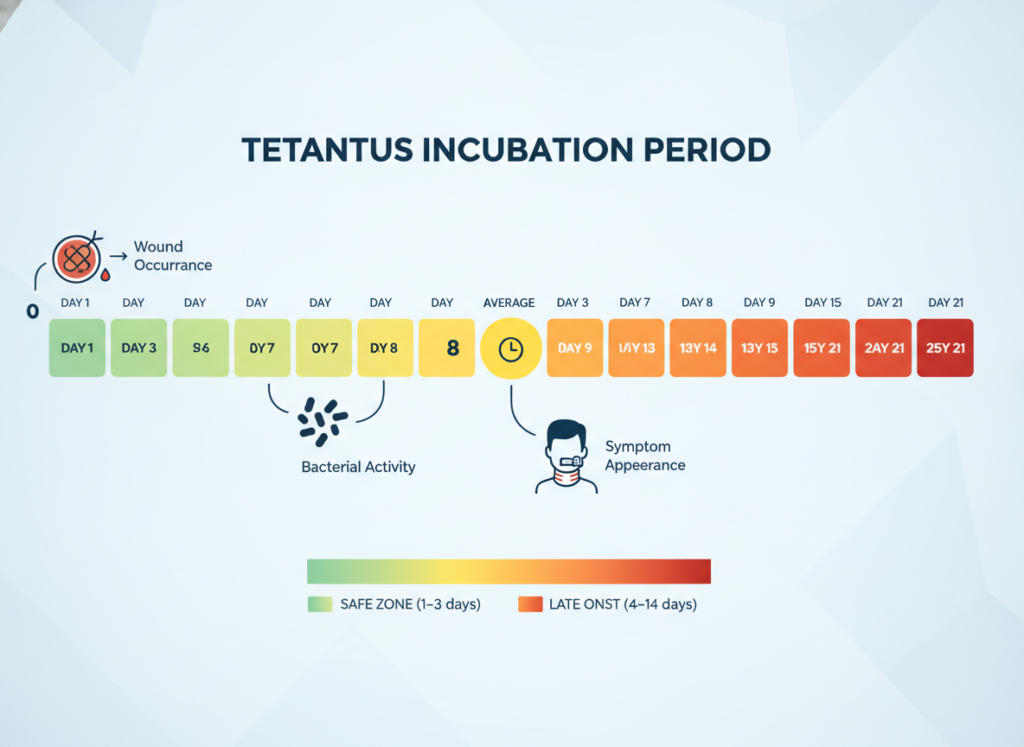
Tetanus symptoms most commonly begin three to twenty-one days after exposure, with most cases appearing within two weeks and an average incubation period of about eight days. A few patients develop signs as early as 1 day after injury, while rare cases may take weeks or longer.
The incubation period starts when Clostridium tetani spores enter damaged tissue — not when you first notice the wound. Spores live widely in soil, dust, and animal waste and can invade through any skin break, from obvious punctures to tiny cuts.
Thanks to vaccination, the United States reports about thirty tetanus cases per year, and most occur in people with incomplete or no immunization. Neonatal tetanus remains a risk in areas with limited sterile birth practices.
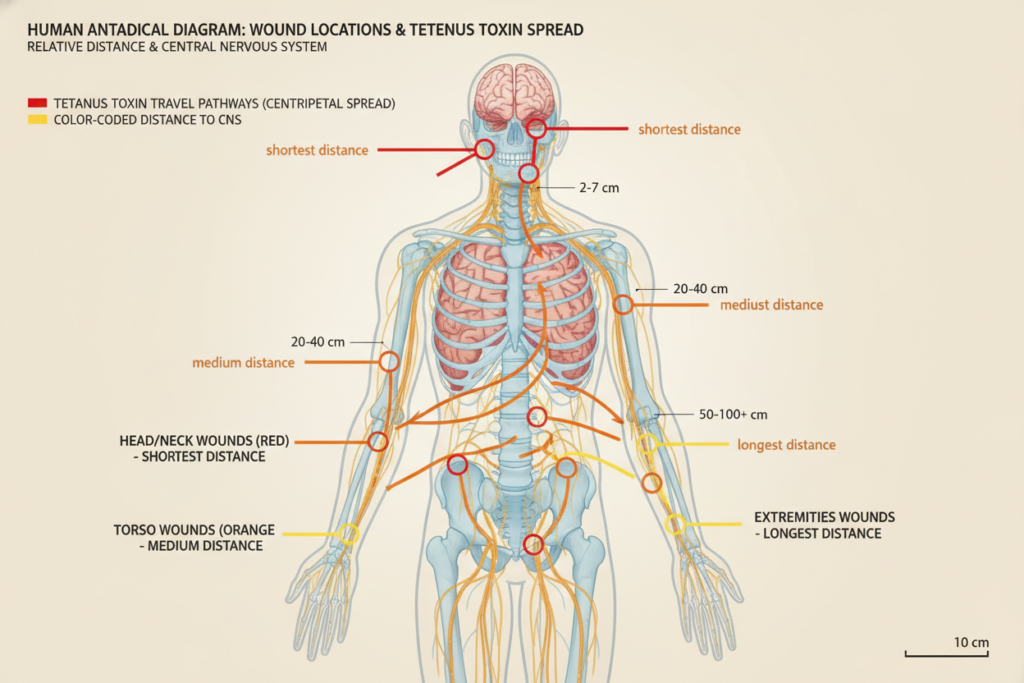
When spores germinate in low-oxygen (anaerobic) pockets of damaged tissue, Clostridium tetani bacteria multiply and release tetanospasmin, a potent neurotoxin. The toxin travels along peripheral nerves toward the central nervous system rather than primarily through the bloodstream, which helps explain why incubation times vary.
Tetanospasmin blocks inhibitory neurotransmitters that normally tell muscles to relax. As the toxin accumulates at nerve endings, muscle stiffness and painful spasms develop — the hallmark signs of tetanus.
Important to Know: You can feel well during most of the incubation period while these dangerous processes occur silently. Prevention with vaccination and prompt wound care is far more effective than treating active toxin effects.
The amount of toxin required to cause symptoms differs between people and depends on wound location, bacterial load, and individual physiology.
Several key factors change how long the tetanus incubation period lasts and how quickly symptoms appear.
Wound location matters: injuries near the head or neck usually lead to shorter incubation because the toxin has a shorter path along nerve pathways to the central nervous system. Depth and tissue damage also matter — deep punctures and crush injuries create low-oxygen pockets where Clostridium tetani spores germinate more readily.
Other factors that raise risk include compromised immunity and the presence of foreign material in the wound. Older adults in the United States often have lower vaccination coverage, which increases their risk of tetanus and more rapid progression.
Appropriate wound care, timely booster vaccination, and tetanus immune globulin when indicated can prevent disease after high-risk exposures.
If you have a high-risk wound — deep, contaminated, or near the head/neck — seek urgent medical evaluation rather than waiting for symptoms.
Early recognition of tetanus symptoms can be lifesaving. Tetanus usually begins with muscle-related signs that steadily worsen if untreated.
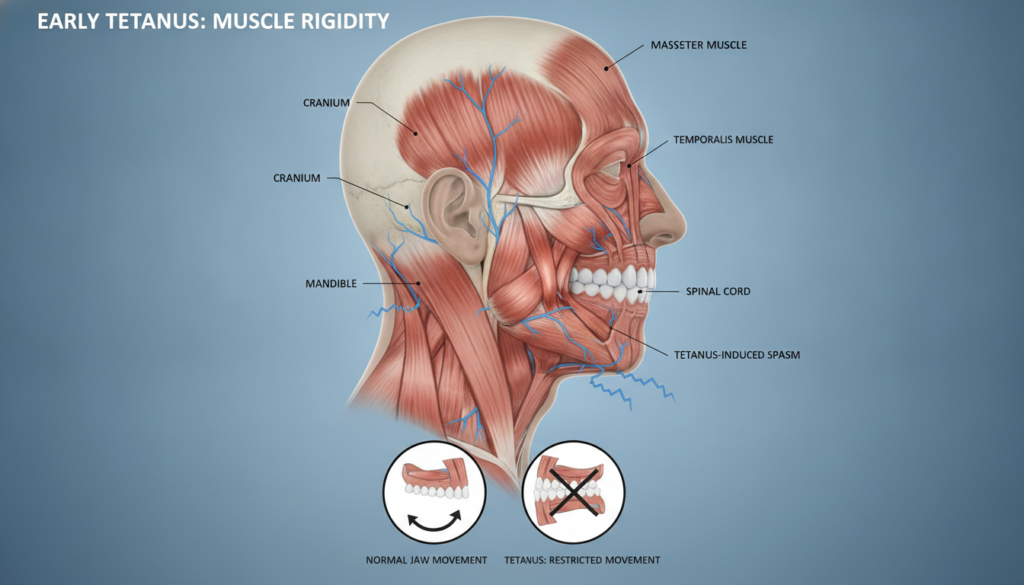
The most common first sign is jaw stiffness, or “lockjaw,” which makes opening the mouth and chewing difficult. Neck stiffness and throat muscle tightness often follow, causing pain, drooling, and trouble swallowing.
As toxin effects spread, abdominal and back muscles stiffen, producing a board-like abdomen and painful generalized spasms. Facial spasms can cause a characteristic grimace called risus sardonicus. Sensitivity to light, sound, or touch may trigger violent spasms.
Localized tetanus may start with stiffness near the wound; generalized tetanus affects multiple muscle groups. Consciousness is usually preserved, so patients remain aware during painful spasms.
New jaw stiffness, difficulty swallowing, severe muscle spasms, or breathing trouble after an injury require urgent medical evaluation. Tetanus can progress from mild symptoms to life-threatening respiratory paralysis within hours to days.
If you are experiencing these symptoms after an injury:
Or contact our urgent care line for guidance:
Tetanus typically starts with facial and jaw stiffness and can generalize rapidly. Rigidity spreads to the neck, chest, abdomen, back, and limbs. Severe, sudden spasms may be triggered by minor stimuli such as noise, touch, or bright light.
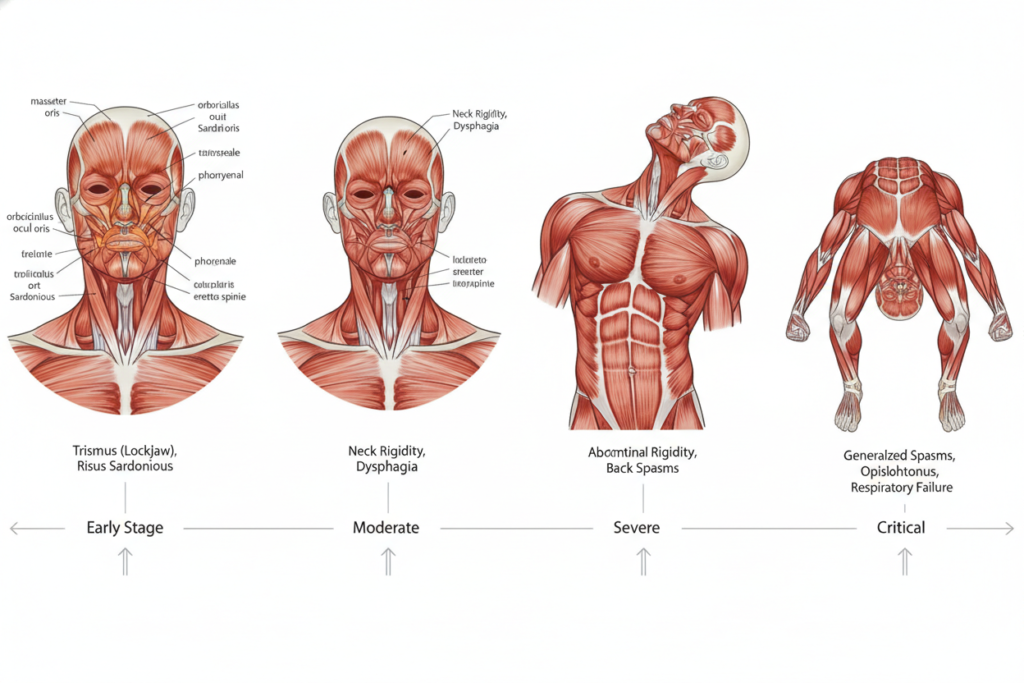
Tetanus spasms are more intense than ordinary cramps and can involve many muscles at once, lasting seconds to minutes and recurring frequently. These episodes are extremely painful and can cause fractures or other injuries.
Threats to breathing are the most dangerous complication: throat or chest muscle involvement can obstruct the airway or limit chest expansion, often requiring mechanical ventilation. Severe cases may also damage autonomic control, causing unstable heart rate and blood pressure.
The time from first symptom to severe disease can be rapid — sometimes 24–48 hours in aggressive cases — so early hospital care improves survival. Intensive care focuses on controlling spasms, securing the airway, and supporting vital functions while toxin effects wear off.
Key point: If you or someone you know develops jaw stiffness or new muscle spasms after a wound, seek emergency care immediately—do not wait.
Tetanus recovery is often long and demanding. Symptoms usually worsen over several days and typically peak within the first week after onset; severe spasms and rigidity can continue for weeks during the acute phase.
Hospital care is frequently required—many patients need intensive monitoring, and the average hospital stay in the United States ranges about three to five weeks for moderate to severe cases. Some people require mechanical ventilation for days to weeks when breathing muscles are affected.
Improvement is gradual because tetanospasmin already bound to nerve endings cannot be quickly removed. Recovery depends on the slow regeneration of nerve connections, so full return to function may take weeks to months and sometimes longer.
During rehabilitation patients often face fatigue, muscle weakness, and limited mobility that require extended physical therapy. Psychological effects—anxiety, depression, or post-traumatic stress—are common and should be addressed.
Neonatal tetanus from an infected umbilical stump follows a different, often faster course and carries much higher mortality where sterile delivery practices and maternal immunization are lacking.
The small amount of toxin that causes tetanus symptoms is insufficient to trigger reliable protective antibodies. Survivors therefore still need vaccination; clinicians typically give tetanus vaccine during recovery to provide future protection.
Long-term complications can persist in some survivors, including chronic pain, residual stiffness, and functional limitations. These risks underscore that prevention via vaccination and prompt wound care is far preferable to treating established disease.
Keep tetanus vaccination up to date: children follow the DTaP series, adolescents receive Tdap, and adults need a Td or Tdap booster every 10 years (or sooner after high-risk wounds). Tetanus immune globulin may be used for immediate protection when indicated.
Questions about your tetanus booster or a wound? Call:
Vaccination is the most effective way to prevent tetanus. Safe, effective tetanus vaccines have dramatically reduced tetanus cases and deaths worldwide; most current U.S. cases occur in people who are unvaccinated or incompletely immunized.

Public health surveillance shows that routine vaccination programs have cut tetanus cases sharply; maintaining immunization, timely boosters, and good wound care keeps both individuals and communities protected.
Tetanus most often develops three to twenty-one days after Clostridium tetani enters a wound, with most cases appearing within two weeks. Once jaw stiffness, swallowing difficulty, or muscle spasms begin, the disease can progress rapidly and requires urgent hospital care.

The incubation period is a silent window when dangerous processes occur without symptoms. Prevention—current vaccination and prompt wound care—is far safer than treating established tetanus. Check your immunization status and seek immediate care for concerning wounds.
If your booster is overdue or you have a high-risk wound, book a consultation. Dr. Vaid will assess the wound and your vaccination history and refer you for the booster if you need one — vaccines are not given at Savera.
Questions? Call:
This article is educational and not a substitute for professional medical advice. For medical emergencies, call 911 immediately.
Medically reviewed by Dr. Meenu Vaid, MD, Board-Certified in Internal Medicine and Infectious Disease. Last clinically reviewed on August 2, 2026.
This article is for general educational purposes only and is not medical advice. Reading it does not create a doctor-patient relationship. For emergencies call 911. For crisis support call or text 988. Read our full medical disclaimer.
Reference: MedlinePlus — Tetanus (U.S. National Library of Medicine).