Quick answer: Addiction, medically known as substance use disorder, is a chronic brain condition, not a lack of willpower or a simple choice. Because it changes how the brain’s reward and self-control systems work, it responds to medical treatment rather than sheer effort, and with the right care the brain can recover.
If you have ever watched someone you love keep using a substance while their life falls apart, you have probably asked the hard question: why don’t they just stop? And if it is you in that struggle, you may have asked something quieter and more painful: what is wrong with me that I can’t?
The honest answer from medicine is that nothing is wrong with your character. Addiction is not weakness. It is a health condition with real, measurable changes in the brain. Understanding that is not an excuse. It is the first step toward the kind of help that actually works.
A quick note on words. Throughout this article we use the clinical term substance use disorder the way your doctor would. “Addiction” is the everyday word for the same thing, usually its more severe end. We use both here so this is easy to follow.
Is addiction a choice?
The first drink, the first pill, the first bet: yes, that is usually a choice. Whether the pull involves alcohol, medications, or a behavioral pattern such as gambling addiction, addiction is what happens after choice stops being the thing in the driver’s seat.
Here is the shift. Early on, a person uses because they want to, to feel good, to feel less, or to cope. Over time, repeated use rewires the brain’s reward and control systems. The behavior stops being about wanting and starts being about needing, just to feel normal and to avoid feeling terrible. At that point, willpower is fighting biology, and biology has a head start.
So the fairer question is not “why won’t they choose to stop?” It is “why has their brain made stopping so much harder than it is for other people?” That question has real answers, and they point toward treatment rather than blame.
Is addiction a disease? What doctors actually mean
When physicians and major medical bodies call addiction a disease, they are not being politically correct. They are describing what the evidence shows.
The American Society of Addiction Medicine defines addiction as a treatable, chronic medical condition involving complex interactions among brain circuits, genetics, the environment, and a person’s life experiences. The National Institute on Drug Abuse describes it as a chronic, recurring disorder marked by compulsive use despite harmful consequences. In everyday terms, “disease” means three things here:
- It has a biological basis. Substance use disorder shows up as consistent, observable changes in how the brain works.
- It is chronic. Like diabetes or high blood pressure, it tends to be long-term and can flare up again after periods of stability.
- It is treatable. Also like those conditions, it responds to medical care, and outcomes improve with the right treatment.
That last point matters most. Calling addiction a disease is not a verdict of hopelessness. It is the opposite. We treat chronic diseases every day, and people live full lives with them.
If you want the full clinical overview of what addiction is, its types, symptoms, and how it is diagnosed, see our companion guide on what addiction is. This article stays focused on the disease-versus-choice question.
What addiction does to the brain
You do not need a neuroscience degree to understand why substance use disorder is so hard to muscle through. Three brain systems get pulled off balance.
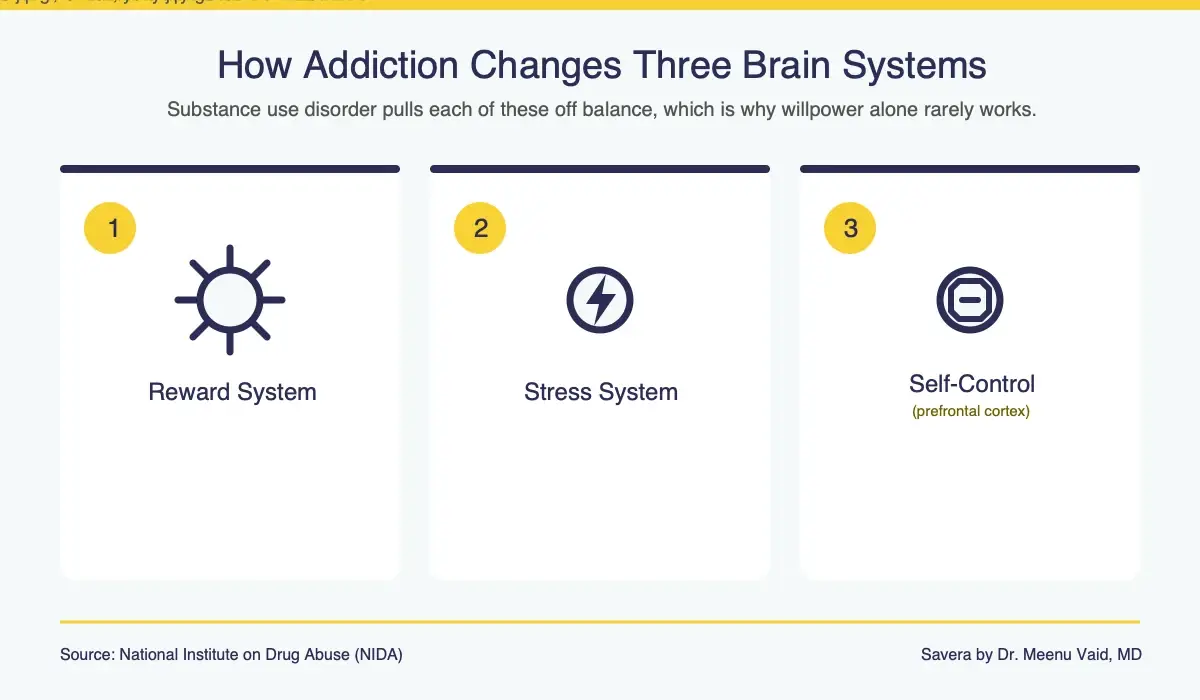
- The reward system. Drugs and alcohol flood the brain with dopamine, far more than everyday pleasures like food or connection. The brain adapts by turning down its own reward signals. Over time, the substance is one of the only things that registers as good, and ordinary life starts to feel flat.
- The stress system. As the brain adapts, it cranks up stress and discomfort when the substance is absent. This is why withdrawal and cravings can feel unbearable, not dramatic, but genuinely hard to sit through.
- The prefrontal cortex. This is the brain’s brake pedal, the part that weighs consequences and says “not now.” Substance use disorder weakens it. So at the exact moment a person most needs judgment and self-control, the circuit that provides them is running at a deficit.
Put those together and you get the trap: stronger pull toward the substance, sharper pain when it is gone, and a weaker brake to stop. That is not a personality flaw. That is a brain under the influence of a medical condition.
Why willpower alone usually fails
If addiction were simply about willpower, then people with the most to lose, careers, children, freedom, would recover the easiest. They don’t. That tells you willpower was never the missing ingredient.
A return to use, often called relapse, is frequently treated as a moral failure. Medically, recurrence is closer to a symptom. When a chronic condition returns, we adjust treatment; we do not tell the patient they didn’t want it badly enough. A landmark study in JAMA found that recurrence rates for substance use disorders are in the same range as other chronic conditions like hypertension and asthma. Nobody calls an asthma flare a lack of discipline.
None of this means effort is pointless. Recovery takes real work. But it is the difference between asking someone to hold their breath through a house fire and handing them a way out. Treatment gives the brain time and support to rebalance, so that effort finally has something solid to stand on.
Is addiction genetic? Who is at higher risk
Substance use disorders run in families, and genetics is a big reason why. Research on twins and families suggests that genes account for roughly half of a person’s risk of developing a substance use disorder, according to the National Institute on Drug Abuse. That does not mean half the population is destined for addiction. It means some people start with a brain that is more vulnerable.
Genes are only part of the story. Risk is shaped by several factors working together:
- Family history and genetics. Having a close relative with a substance use disorder raises your risk.
- Age of first use. The earlier someone starts, especially in the teen years while the brain is still developing, the higher the risk.
- Mental health. Conditions like depression, anxiety, and trauma often travel alongside substance use, each one feeding the other. Treating both together, sometimes called dual diagnosis care, tends to work better than treating either alone.
- Environment. Chronic stress, early exposure, and easy access all play a role.
The key idea is this: risk is not destiny. A higher-risk brain is a reason to be informed and to seek help early, not a sentence. Plenty of people with strong family histories never develop a disorder, and plenty with the condition go on to lasting recovery.
If it is a disease, how is it treated?
Here is the hopeful part, and it follows directly from everything above. If addiction is a brain condition, then the goal of treatment is to help the brain heal, and that is something medicine knows how to support.
Effective addiction medicine care usually combines a few elements: FDA-approved medications that ease cravings and steady brain chemistry, evidence-based therapy that rebuilds coping and decision-making, and treatment for any co-occurring mental health conditions. Over time, this combination gives those three brain systems, reward, stress, and control, the chance to rebalance. Many people find that cravings quiet, judgment returns, and ordinary life starts to feel good again.
At Savera, Dr. Meenu Vaid provides personalized, judgment-free substance use disorder treatment in Morgan Hill and via telehealth across California. If you or someone you love is struggling, reaching out is not an admission of weakness. It is the same thing you would do for any other medical condition: talk to a doctor who can help.
Please note: We do not offer inpatient care, group therapy, or in-house cognitive behavioral therapy (CBT). However, we maintain a strong referral network and can connect patients to trusted providers for these services as needed.
Frequently asked questions
Is addiction a disease or a choice?
Can the brain recover from addiction?
Is addiction hereditary?
Does calling addiction a disease remove personal responsibility?
Is substance use disorder the same as addiction?
Is addiction curable?
Medically reviewed by Dr. Meenu Vaid, MD, Board-Certified in Addiction Medicine (ABPM). Last clinically reviewed on October 24, 2026.
This article is for general educational purposes only and is not medical advice. Reading it does not create a doctor-patient relationship; see our full medical disclaimer. For emergencies call 911. For crisis support call or text 988, or reach the free, confidential SAMHSA National Helpline at 1-800-662-HELP.