
Quick answer: To stop social media addiction, turn off every notification, move the apps off your home screen, and set your phone to grayscale. Then pick specific times to check rather than grazing, and replace scrolling with one planned activity. Cutting 15 to 30 minutes a week is more sustainable than quitting cold.
You did not plan to lose an hour tonight. You picked up your phone to check one thing, and now it is late, your eyes hurt, and you feel worse than before you started. If that sounds familiar, you are in very ordinary company, and you are not weak for finding it hard to stop.
These apps are built by teams whose job is to keep you scrolling. Losing to that design is not a character flaw. But it is worth taking seriously, because the cost shows up in your sleep, your attention, and your mood. This guide covers what the real warning signs look like, why your brain fights you when you try to quit, and the steps that actually make a difference.
Is social media addiction real?
Here is the honest answer, and it is more nuanced than most articles admit: “social media addiction” is not a formal medical diagnosis.
In the American Psychiatric Association’s diagnostic manual, gambling disorder is the only behavioral addiction recognized as a standalone diagnosis. Internet gaming disorder appears in a separate section reserved for conditions that still need more research, and the APA is explicit that this proposed condition does not cover general internet use, social media, or smartphones. The World Health Organization’s classification recognizes gambling and gaming disorder, but not social media use either.
So no, you cannot be diagnosed with social media addiction. That does not mean nothing is wrong.
Problematic social media use is real, it is measurable, and it responds to treatment. When clinicians assess it, they look at the same things that define any addictive pattern: loss of control over how much you use, harm showing up in your life, and continued use anyway. You do not need a diagnosis code to deserve help with that.
Signs and symptoms of social media addiction
Almost everyone has lost an evening to their phone. One late night is not a problem. What matters is a pattern that repeats and sticks around, usually across three areas at once.
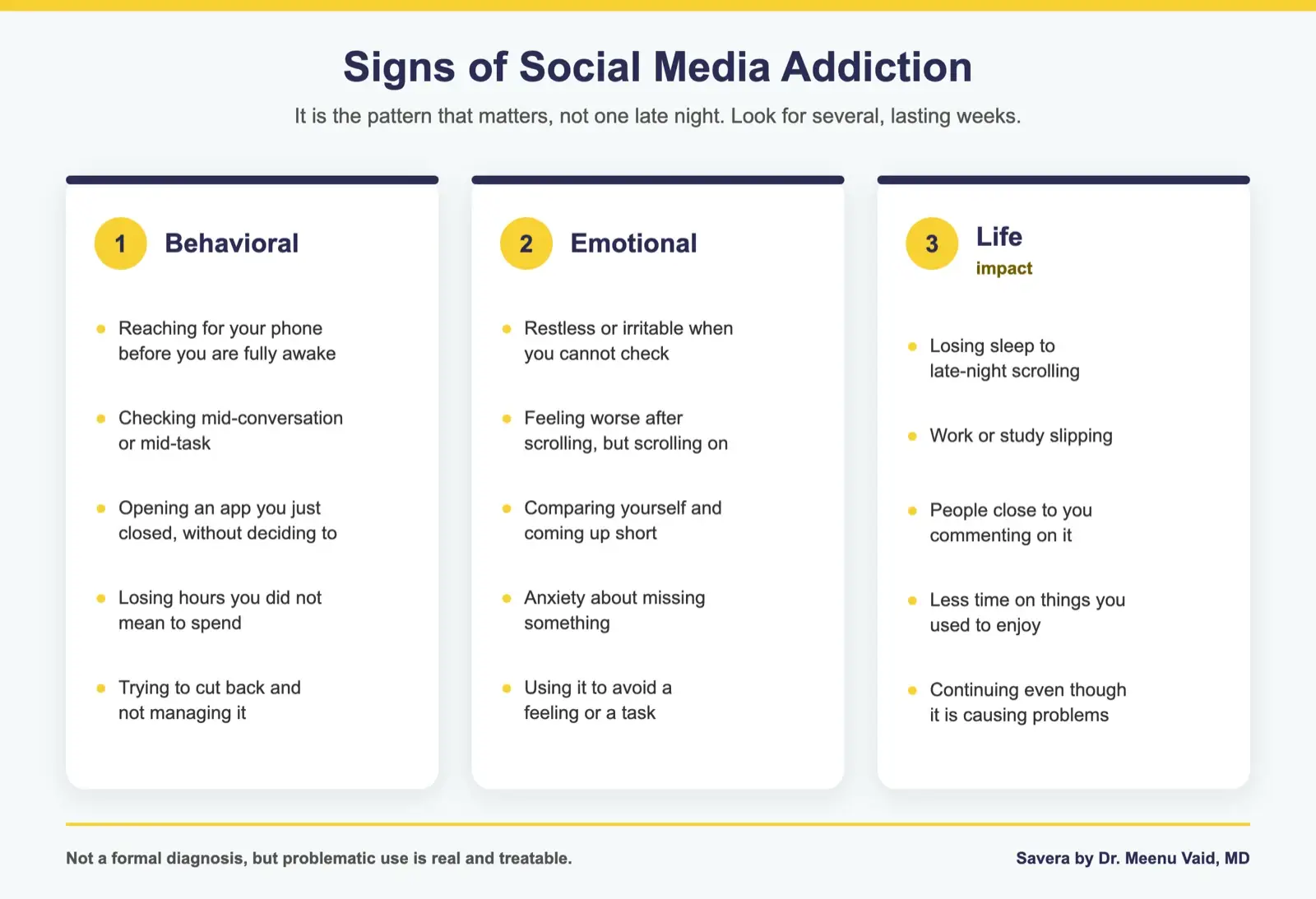
Behavioral signs
- Reaching for your phone before you are fully awake
- Checking mid-conversation or mid-task, without really deciding to
- Opening an app seconds after you closed it
- Losing hours you did not mean to spend
- Trying to cut back and not managing it
Emotional signs
- Feeling restless or irritable when you cannot check
- Feeling worse after scrolling, and scrolling on anyway
- Comparing yourself to other people and coming up short
- Anxiety about missing something
- Using it to avoid a feeling or a task you are dreading
Life impact
- Losing sleep to late-night scrolling
- Work or study quietly slipping
- People close to you commenting on your phone use
- Less time on things you used to enjoy
- Continuing even though it is clearly causing problems
That last one carries the most weight. Doing something repeatedly despite real consequences is the clearest signal that a habit has become something more. If you recognize several of these and they have lasted weeks rather than days, it is worth acting on.
Why your brain resists stopping
Understanding the mechanism helps, because it moves the problem from “what is wrong with me” to “what am I up against.”
Social feeds run on unpredictable rewards. Most of what you see is forgettable, but every so often something lands: a message that matters, a post that makes you laugh, a number that went up. Because you cannot predict which scroll delivers it, the anticipation keeps you going. It is the same mechanic that makes slot machines compelling, and it is far stickier than a reliable reward would be.
Dopamine gets blamed for this, usually inaccurately. It is less the chemical of pleasure and more the chemical of seeking. It rises in anticipation, before the reward, which is why the pull to check is strongest before you look and why the payoff so often disappoints. Our post on whether a dopamine detox actually works goes further into it.
The products also remove every natural stopping point. Infinite scroll means the page never ends. Autoplay starts the next thing before you decide. Streaks and notifications manufacture a reason to come back. You are not failing to stop. You are using something engineered to have no obvious place to stop.
How to stop social media addiction: what actually works
Willpower alone is a poor strategy, because it asks you to win the same argument dozens of times a day. Changing your environment works better, because you only have to decide once.
Start by measuring, not cutting. Before you change anything, look at your phone’s built-in screen time report for a week. Most people are genuinely surprised. You cannot tell whether a change is working without a starting number.
Turn off notifications. Not just some. All of the social ones. Every notification is an invitation you did not ask for, and this single change does more than almost anything else on this list.
Add friction. Move the apps off your home screen and into a folder. Log out so you have to type a password. Delete the app and use the browser version, which is deliberately worse. Switch your screen to grayscale. Each step is small, and each one buys you a second to notice what you are doing.
Give it a time and a place. Banning yourself outright tends to backfire. Deciding that you check after lunch and after dinner, for a set amount of time, works better because it replaces a vague urge with a clear rule.
Get it out of the bedroom. Charge the phone in another room and use a real alarm clock. This protects your sleep and removes both the last scroll of the night and the first of the morning.
Replace, do not just remove. This is the step people skip, and it is why most attempts fail. Scrolling fills a gap: boredom, loneliness, avoidance, or the need to decompress. If you remove it without putting anything in its place, the gap simply pulls you back. Decide in advance what you will do instead, and make it specific. A book on the nightstand beats “read more.” A walk after dinner beats “get outside.” Our guide to a practical digital detox has more on structuring this.
Expect it to feel strange for a while. The first few days are usually the hardest, and boredom will feel surprisingly loud. That settles.
What about TikTok specifically?
People often say they can manage other apps but not this one. That is not your imagination.
Short-form video shortens the reward cycle to a few seconds, so you get many more chances at a hit in the same time. The feed is also almost entirely algorithmic, so you are not limited by what your friends posted. There is always more, and it targets you better the longer you watch. Add autoplay, and there is no natural gap in which to stop.
The same tools work, with more force behind them. Set a daily limit in the app and treat it as real. Clear your watch history so the recommendations lose their grip. Most people find this one is easier to remove entirely than to moderate.
When it is more than a habit
Most people can turn this around with the steps above. Some cannot, and that is worth naming rather than pushing through.
See a doctor about social media use if you have tried more than once to cut back and could not, if it is clearly harming your sleep, work, studies, or relationships and continues anyway, or if stopping leaves you genuinely distressed rather than just restless. Anxiety, depression, and ADHD often sit underneath the habit, and treating them together works better than attacking the phone use alone.
It is also worth an evaluation if the scrolling sits on top of something else. Anxiety, depression, ADHD, and loneliness very often travel with heavy social media use, and each one makes the other harder to shift. Treating them together works better than attacking the phone habit on its own.
At Savera, Dr. Meenu Vaid offers judgment-free care for social media and behavioral addiction for adults in Morgan Hill, in person and by telehealth. If you are a parent worried about a teenager rather than yourself, start with our guide to tech and behavioral addictions in teens. And if you are not sure whether what you are experiencing counts as a problem, that uncertainty is exactly what an evaluation is for. Reach out and talk it through.
Please note: We do not offer inpatient care, group therapy, or in-house cognitive behavioral therapy (CBT). However, we maintain a strong referral network and can connect patients to trusted providers for these services as needed.
Frequently asked questions
Is social media addiction a real diagnosis?
How many hours a day is too much?
Can you be addicted to social media?
What are the first signs I am addicted to social media?
Does deleting the app actually work?
Why is TikTok harder to stop than other apps?
When should I see a doctor about social media use?
Medically reviewed by Dr. Meenu Vaid, MD, Board-Certified in Addiction Medicine. Last clinically reviewed on July 26, 2026.
This article is for general educational purposes only and is not medical advice. Reading it does not create a doctor-patient relationship. For emergencies call 911. For crisis support call or text 988.