
Quick answer: Common signs of vaping in teens include an unfamiliar sweet or fruity smell, small USB-shaped devices or pods, increased thirst, nosebleeds, a lingering cough, and new irritability. Nicotine reaches the brain within seconds, and a teenage brain forms dependence faster than an adult one.
Most parents do not find out because their teenager tells them. They find out because something small does not add up. A sweet smell in a bedroom that does not match any candle in the house. A device on a nightstand that looks like a flash drive. A kid who suddenly needs a water bottle everywhere.
If you are reading this because of something you noticed, that instinct is worth taking seriously. Vaping is easy to hide by design. The devices are small, the aerosol clears quickly, and the flavors smell like anything but tobacco.
What follows is what to look for, what nicotine actually does to a developing brain, and how to open the conversation without ending it in the first sentence.
What are the signs of vaping in teens?
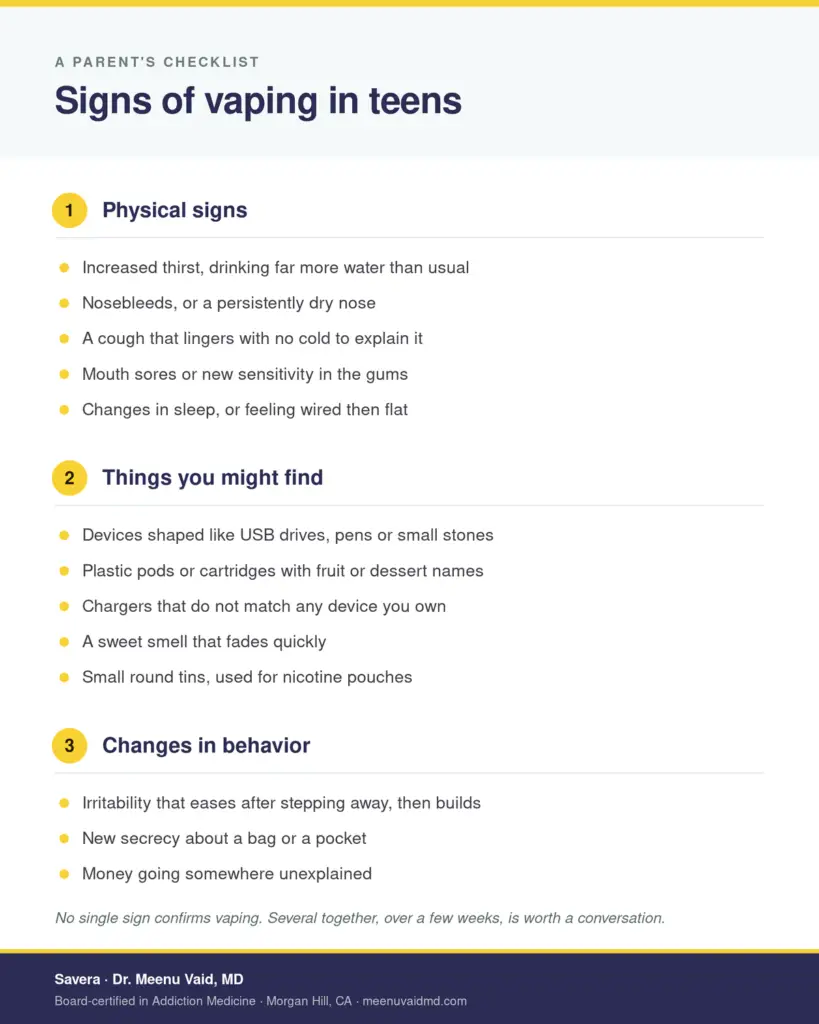
There is rarely one obvious sign. It is usually a cluster of small changes that only make sense together.
Physical signs
Nicotine and the other ingredients in vape aerosol are drying and irritating. The most common physical signs parents notice are:
- Increased thirst, and drinking far more water than usual
- Nosebleeds, or a persistently dry or bloody nose
- A cough that lingers with no cold to explain it
- Mouth sores, or new sensitivity in the gums
- Changes in sleep, or feeling wired then flat
None of these on its own means your teen is vaping. Several appearing together, over a few weeks, is worth paying attention to.
Things you might come across
Vape devices are built to be discreet. Many look like USB flash drives, highlighter pens, or small stones. Others look like a chunky remote control. You may also find:
- Small plastic pods or cartridges, often with fruit or dessert names
- Unfamiliar chargers, particularly ones that do not match any device you own
- Empty foil packets or unexplained small boxes
- A sweet smell on clothing, in a car, or in a bedroom that fades quickly
Changes in behavior
Nicotine dependence has a rhythm to it, and that rhythm shows. Watch for irritability that eases after your teen steps away for a few minutes, then builds again. New secrecy about a bag or a pocket. Money going somewhere unexplained. Longer, more frequent trips to the bathroom, including during the night.
These patterns matter more than any single object you might find.
Why is vaping harder on a teenage brain?
The adolescent brain is still under construction, and it keeps developing into the mid-twenties. The regions that handle impulse control and judgement are among the last to finish.
Nicotine acts directly on the brain’s reward pathways, and it acts fast. In a brain that is still wiring those pathways, repeated nicotine exposure can shape them. That is why dependence tends to form more quickly in teenagers than in adults, and why quitting later can be harder for someone who started young. The U.S. Surgeon General’s report on youth e-cigarette use covers this in detail.
This is also why the common reassurance that vaping is “just water vapor” is worth pushing back on gently. It is not water, and the nicotine is the part that changes the brain.
What is actually in a vape?
Vape aerosol is not steam. It is a mix of nicotine, a carrier liquid, flavoring compounds, and fine particles that come from heating that liquid against a metal coil.
Two things are worth knowing. First, many pod-style products use nicotine salts, a formulation that delivers a high concentration of nicotine without the harshness that would normally make someone cough and stop. A teenager can take in a substantial amount without it feeling like much.
Second, the aerosol carries more than nicotine. The Centers for Disease Control and Prevention notes it can contain ultrafine particles that reach deep into the lungs, flavoring chemicals, and trace metals from the heating element. The FDA maintains current information on regulated products and their contents, and the National Institute on Drug Abuse publishes a plain-language overview of how these devices work and what they deliver.
Flavor is doing most of the work here. In the 2024 survey, 87.6 percent of students who vaped used a flavored product. That is also why a sweet smell is one of the more reliable signs on the list above, because almost nothing about a vape smells like tobacco.
How common is teen vaping?
Fewer teenagers vape than a few years ago. The 2025 National Youth Tobacco Survey found that 5.2 percent of U.S. middle and high school students had used an e-cigarette in the past 30 days, continuing a decline that has run since 2022.
The number that matters more to a parent is what use looks like among the teens who do vape. In the 2024 survey, 38.4 percent of students who currently vaped had done so on at least 20 of the previous 30 days, and 26.3 percent vaped every day. That is not experimenting. That is a pattern of daily use, and daily use is what dependence looks like.
What about nicotine pouches?
Worth knowing about, because they are easy to miss entirely. Nicotine pouches are small white pouches placed between the lip and gum. There is no device to find, no vapor, and no smell. A teenager can use one at the dinner table without anyone noticing.
They are sold in flavors and marketed as a cleaner alternative, and many teens genuinely believe they are harmless because nothing is being inhaled. The nicotine and the dependence risk are the same. If you have ruled out vaping but the behavioral signs are still there, small round tins in a bag or a pocket are worth a second look.
How do you talk to your teen about vaping?
The opening line matters more than the rest of the conversation. If it sounds like an accusation, you will get a denial, and the subject closes for months.
A few things that help:
- Pick a low-stakes moment. Side by side beats face to face. In the car, on a walk, doing dishes. Less eye contact makes hard subjects easier.
- Ask before you tell. “What do kids at school say about vaping?” gets further than “Are you vaping?” You learn more, and they are not immediately defending themselves.
- Be curious about the appeal. Stress, fitting in, boredom, and anxiety are common reasons. Understanding which one is in play tells you what actually needs solving.
- Skip the ultimatum as an opener. Consequences may have a place later. Leading with them ends the conversation before you learn anything.
- Expect more than one conversation. The first one is rarely the useful one. It signals that you are approachable, which is what makes the second one possible.
If your teen does admit to vaping, how you react in that moment shapes whether they come to you next time. Calm is more useful than correct.
When should you talk to a doctor?
Consider making an appointment if you notice signs of dependence rather than experimentation:
- Vaping within a short time of waking up
- Trying to stop and not being able to
- Continuing to vape through a cold, a cough, or illness
- Real distress, anger, or anxiety when access is removed
- Vaping alongside low mood, anxiety, or sleep problems
Vaping alongside low mood or anxiety is the one to pay closest attention to. Nicotine is often doing a job for the teenager who uses it, usually managing stress. Treating the vaping without looking at what sits underneath it tends not to hold.
A visit starts with questions rather than consequences. Dr. Vaid is board certified in Addiction Medicine and sees teens and families both together and separately, because teenagers will often say things without a parent in the room that they will not say with one.
A first appointment usually covers how much your teen is using and when, what the nicotine seems to be doing for them, whether anything else is going on with mood, sleep, or school, and what they themselves want. That last question matters more than it sounds. A plan a teenager has helped build has a far better chance than one handed to them.
Savera is out-of-network by design, so appointments are unhurried and your teen’s medical record stays private. HSA and FSA are accepted, and we are upfront about cost on the first call. You can read more about addiction medicine care at Savera, or about teenage substance use more broadly.
For related reading, see our guides on cannabis and teen health and smoking and nicotine treatment.
Frequently asked questions
Is vaping safer than smoking for teens?
Can a teen become dependent on nicotine quickly?
What do vape devices actually look like?
How do I help my teen stop vaping?
Are nicotine pouches safer than vaping?
Medically reviewed by Dr. Meenu Vaid, MD, Board-Certified in Internal Medicine, Infectious Disease, and Addiction Medicine.
Last clinically reviewed: July 31, 2026
This page is for educational purposes only and does not constitute medical advice. Reading it does not create a doctor-patient relationship. If you are in immediate danger, call 911. For 24/7 mental health and substance use crisis support, call or text 988. Read our full medical disclaimer.