
Quick answer: Teenage substance abuse means a teen’s use of alcohol, nicotine, or drugs has started to harm their health, school, or relationships. It is common and treatable, and it is most manageable when caught early. This guide covers the warning signs, why it happens, and the steps to take.
If you are reading this, you are probably worried about a specific teenager, and that worry is not something to apologize for. Catching a problem early is one of the most protective things a parent can do. This guide will help you tell the difference between typical teen behavior and a real warning sign, understand why adolescence makes substance use so risky, and know exactly what to do next.
We will use plain language, and we will be honest. Most teens who try a substance do not go on to develop a disorder. But teen brains are uniquely vulnerable, and early use raises the odds. Knowing what to watch for is how you tilt those odds back in your child’s favor.
What counts as teenage substance abuse?
Not every teen who tries alcohol or cannabis has a substance abuse problem. The line is about harm and control. Doctors look at whether use is starting to interfere with a teen’s health, school, friendships, or family, and whether the teen keeps using despite those problems.
Clinicians use the term substance use disorder and rate it mild, moderate, or severe based on how many warning signs are present. “Substance abuse” is the everyday phrase for the same territory. The takeaway for a parent is simpler than the labels: occasional experimentation is common, but a pattern of use plus visible fallout is the signal to act.
Warning signs your teen may be using
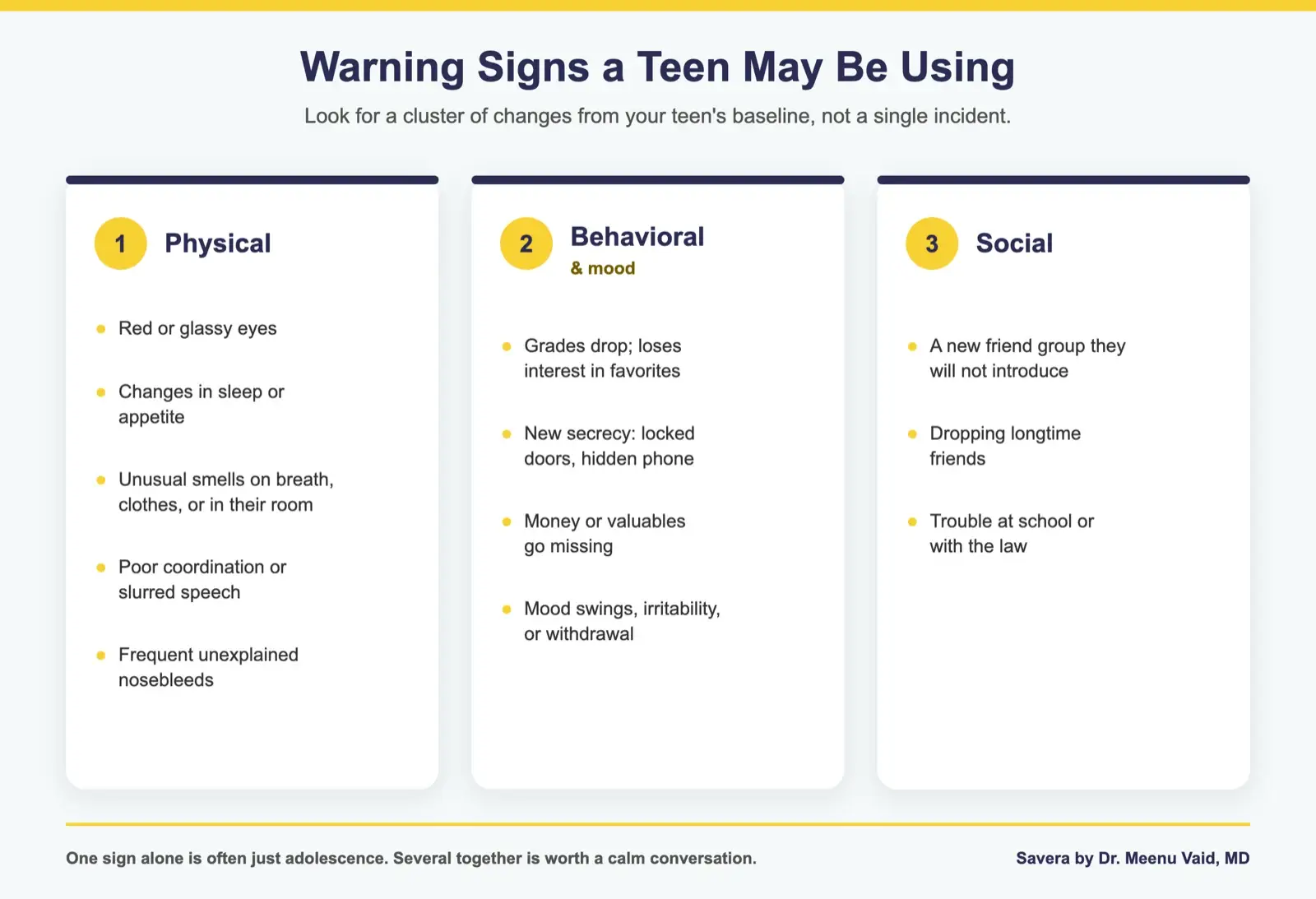
No single sign proves anything. Teens are moody and private by nature. What matters is a cluster of changes that appear together and stick around. Watch for shifts across three areas.
Physical signs
- Red or glassy eyes, or frequent unexplained nosebleeds
- Changes in sleep or appetite
- Unusual smells on breath, clothes, or in their room
- Poor coordination, slurred speech, or unexplained shakiness
Behavioral and mood signs
- A sudden drop in grades or loss of interest in activities they used to love
- New secrecy: locked doors, cleared phone history, vague answers about where they have been
- Money or valuables going missing, or asking for money without explanation
- Big mood swings, irritability, or withdrawal from the family
Social signs
- A new friend group they will not introduce you to
- Dropping longtime friends
- Getting into trouble at school or with the law
One or two of these, on their own, may just be adolescence. Several at once, especially a sharp change from your teen’s baseline, is worth a calm, direct conversation and, if it continues, a professional evaluation.
Why are teens especially vulnerable?
It is not weakness or bad parenting. Adolescence is a biologically high-risk window, and several forces stack on top of each other.
- The teenage brain is still under construction. As the National Institute on Drug Abuse explains, the brain’s reward system matures years before the prefrontal cortex, the part that weighs consequences and applies the brakes. That gap means teens feel the pull of a reward strongly while the “stop and think” system is still coming online. Substances are also more likely to cause lasting changes in a developing brain than in an adult one.
- Peer influence peaks. Fitting in matters enormously at this age, and a substance offered by a friend carries social weight an adult offer never would.
- Social media normalizes and even supplies. Feeds can make substance use look routine, and some platforms have become places where teens encounter, and in some cases obtain, substances. For the behavioral side of screens and social platforms, see our guide to tech and behavioral addictions in teens.
- Stress and trauma. Academic pressure, anxiety, depression, and past trauma are powerful drivers. Many teens use to cope with feelings they do not have other tools for yet. When a mental health condition and substance use appear together, treating both at once works better than treating either alone.
The substances teens use most
The landscape has shifted. The most recent Monitoring the Future survey from the National Institute on Drug Abuse finds that alcohol, nicotine vaping, and cannabis remain the substances adolescents use most. A few categories matter most today.
- Vaping and nicotine. Now one of the most common forms of teen substance use, and the devices are easy to hide. Nicotine is highly addictive to a developing brain.
- Alcohol. Still the most widely used substance among teens. Binge drinking is the pattern of greatest concern. For how alcohol problems escalate, see our guide on teen drinking and alcohol use disorder.
- Cannabis. As our guide to cannabis and teen health explains, today’s products are far more potent than a generation ago, which changes the risk for a developing brain. If your teen drives, our state-by-state guide to teen marijuana DUI laws breaks down the legal side.
- Prescription medication misuse. Stimulants and painkillers taken from a medicine cabinet or shared by peers. More on this in teens and prescription drug misuse.
- Fentanyl in counterfeit pills, the deadliest change. The U.S. Drug Enforcement Administration’s One Pill Can Kill campaign warns that counterfeit pills made to look like real prescription medication are frequently laced with fentanyl, and that roughly 6 out of 10 now contain a potentially lethal dose. This is the risk every parent should understand: a teen who thinks they are taking one thing may be taking something that can kill on the first use.
Are girls and boys affected differently?
Yes, in ways worth knowing. Research suggests boys are somewhat more likely to use substances overall, but the gap has narrowed, and girls face some distinct risks. Girls are more likely to use substances to cope with anxiety, depression, or body-image and social pressures, and, as the National Institute on Drug Abuse notes, they can progress from first use to a disorder faster than boys, a pattern sometimes called “telescoping.” Boys are more likely to use in social or risk-taking contexts and can be less likely to talk about the feelings underneath. The parenting lesson is the same for both: watch for the emotional drivers, not just the behavior, and open the door to conversation without judgment.
How to talk to your teen (without pushing them away)
The goal of the first conversation is not a confession. It is to stay connected so your teen keeps talking to you.
- Pick a calm moment, not the middle of a fight. Side-by-side settings, like a car ride, often work better than a face-to-face confrontation.
- Lead with concern, not accusation. “I’ve noticed some changes and I’m worried about you” opens a door. “I know you’re using drugs” slams it.
- Ask and listen more than you lecture. Curiosity gets you further than a speech.
- Avoid ultimatums and shame. They tend to drive the behavior underground.
- Be clear that your love is not conditional on this. Teens who feel they will lose you are the ones who hide the most.
You cannot force insight, but you can make yourself the safe person your teen turns to. That relationship is one of the strongest protective factors there is.
When and how to get professional help
Trust your instinct. If the signs are adding up, or if there is any risk of fentanyl exposure, do not wait to see if it passes. A professional evaluation is the same reasonable step you would take for any other health concern.
A doctor can assess how far things have gone, screen for co-occurring anxiety or depression, and build a plan matched to your teen. Early, evidence-based care changes outcomes. If you ever need immediate, free, and confidential guidance, the SAMHSA National Helpline (1-800-662-HELP) is available around the clock.
At Savera, Dr. Meenu Vaid offers compassionate, judgment-free addiction medicine care for teens and families in Morgan Hill. If you are unsure whether what you are seeing is serious, that uncertainty is exactly what an evaluation is for. Reach out to talk it through.
Please note: We do not offer inpatient care, group therapy, or in-house cognitive behavioral therapy (CBT). However, we maintain a strong referral network and can connect patients to trusted providers for these services as needed.
What family-based treatment looks like
If you start looking into treatment for a teenager, you will keep running into family therapy. That is not a scheduling convenience. For adolescent substance use, the approaches with the strongest evidence behind them treat the family as part of the work rather than as visitors to it.
Four models come up most often, and it helps to recognise the names when a programme lists them:
- Multidimensional Family Therapy (MDFT) works on four fronts at once: the teenager, the parent, the way the two of them interact, and the systems around them such as school and probation.
- Functional Family Therapy (FFT) is short-term and structured, and starts by lowering the blame in the house before it moves on to skills.
- Brief Strategic Family Therapy (BSFT) targets the specific interaction patterns that keep the behaviour going.
- Multisystemic Therapy (MST) is intensive and delivered where the family lives, usually for teenagers with serious behavioural problems alongside substance use.
SAMHSA’s guidance on family counselling approaches sets out how these differ and who each one suits. The research on BSFT is also blunt about something parents rarely get told: a large part of the work is engagement itself, because the families who most need help are often the hardest to get through the door.
Savera does not provide family therapy in-house. What Dr. Vaid can do is assess your teenager, treat the medical side, and point you toward the right kind of programme rather than the first one that comes up in a search. If you are weighing options, that is a conversation worth having before you commit to anything.
Frequently asked questions
Is teen experimentation normal, or is it abuse?
What are the first signs a teen is using drugs?
Can vaping lead to other drug use?
How do I get my teen evaluated?
Is it my fault?
Where can I get help for my teen in Morgan Hill?
Medically reviewed by Dr. Meenu Vaid, MD, Board-Certified in Addiction Medicine. Last clinically reviewed on July 24, 2026.
This article is for general educational purposes only and is not medical advice. Reading it does not create a doctor-patient relationship. For emergencies call 911. For crisis support call or text 988.