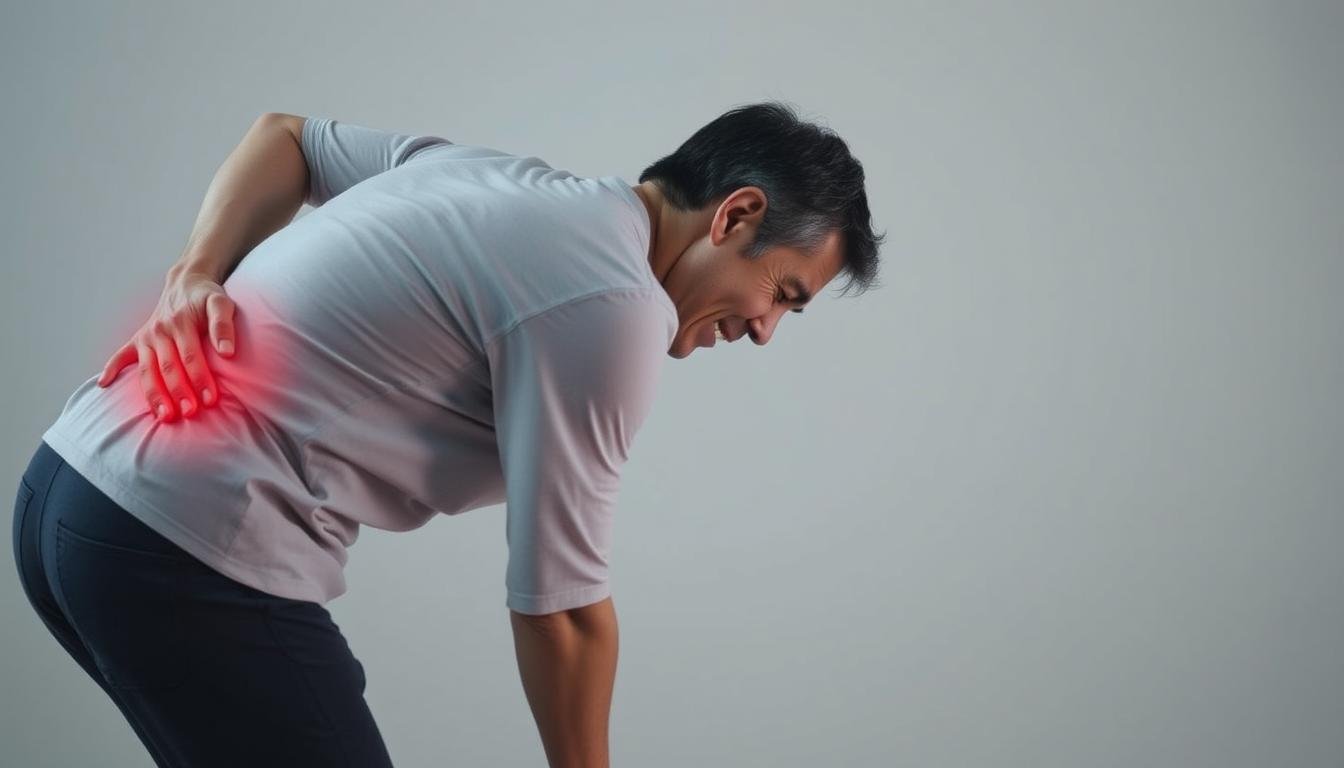
Quick answer: Fear of movement, or kinesiophobia, is common in chronic pain: after an injury the brain learns to expect pain and makes you avoid activity, which leads to stiffness, weakness, and more pain. Pain Reprocessing Therapy helps break this cycle by teaching the brain that safe movement is not dangerous, so you can gradually move and live more freely.
Fear of Movement and Chronic Pain: A Practical Guide to Pain Reprocessing Therapy
If you live with chronic pain, you probably already know this feeling: a part of your brain that used to make decisions about your life now spends most of its energy keeping you safe from movement. You stop bending. You stop lifting. You stop the hike, the garden, the morning walk. Each thing you give up was supposed to protect you. None of it does.
The medical term is kinesiophobia, or fear of movement. Researchers estimate that some degree of it affects most people with persistent pain. And the data has gotten remarkably clear about what to do about it.
In 2022, the trial known as the Boulder Back Pain Study randomized 151 adults with chronic back pain to either Pain Reprocessing Therapy (PRT), a placebo injection, or usual care. After four weeks, 66% of the PRT group were pain-free or nearly pain-free. The placebo group came in at 20%, usual care at 10%. Effects were largely maintained at one year (Ashar et al., 2022; 5-year follow-up).
That trial is the reason I started training in PRT and started using it with patients in Morgan Hill. The technique addresses something traditional pain medicine often misses: that in long-standing chronic pain, the most important repair work is in the brain’s threat-detection system, not the tissue.
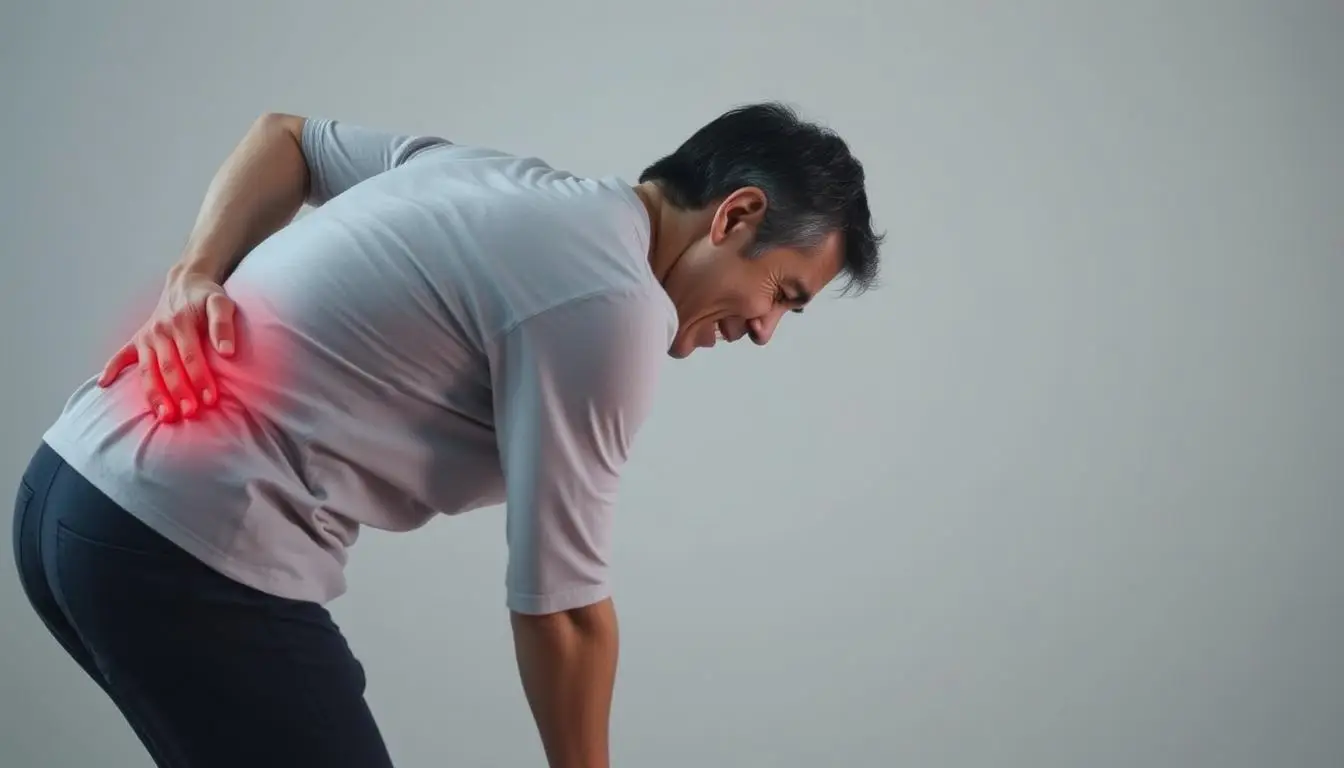 This guide walks through what fear of movement is, why it perpetuates chronic pain, and how PRT changes the picture.
What fear of movement actually is
Pain is a danger signal. That is what it is supposed to be. When you injure something, the brain learns the lesson quickly: that movement, in that position, hurt. Avoid it. The lesson is useful in the short term.
In chronic pain, the lesson outlives the injury. Even after tissue heals, the brain often keeps the alarm wired to the same triggers. You bend forward. The brain says “wait, that bend hurt last time.” It fires the pain signal as a warning. You flinch and stop, which the brain interprets as confirmation that the warning was right. Next time you try the same movement, the alarm comes earlier and louder.
That is the fear-avoidance cycle in plain language: pain leads to fear, fear leads to avoidance, avoidance leads to more pain and more disability. The pain in this cycle is real. It is generated by real neurons firing real signals. It is just no longer reporting on tissue damage. It is reporting on a learned association the brain has not been given a reason to unlearn.
Several things make this pattern stickier than it should be:
- Past injuries that produced significant pain
- Imaging reports that emphasize structural findings (“disc bulge,” “degeneration”)
- Well-meaning advice that frames the spine as fragile (“don’t bend or you’ll hurt yourself”)
- Watching other people get injured doing similar movements
None of these are character flaws. They are predictable consequences of how human nervous systems are built. They are also, fortunately, what PRT was designed to change.
How fear keeps the pain going
When you avoid movement, three things happen at the same time, and each one feeds the others.
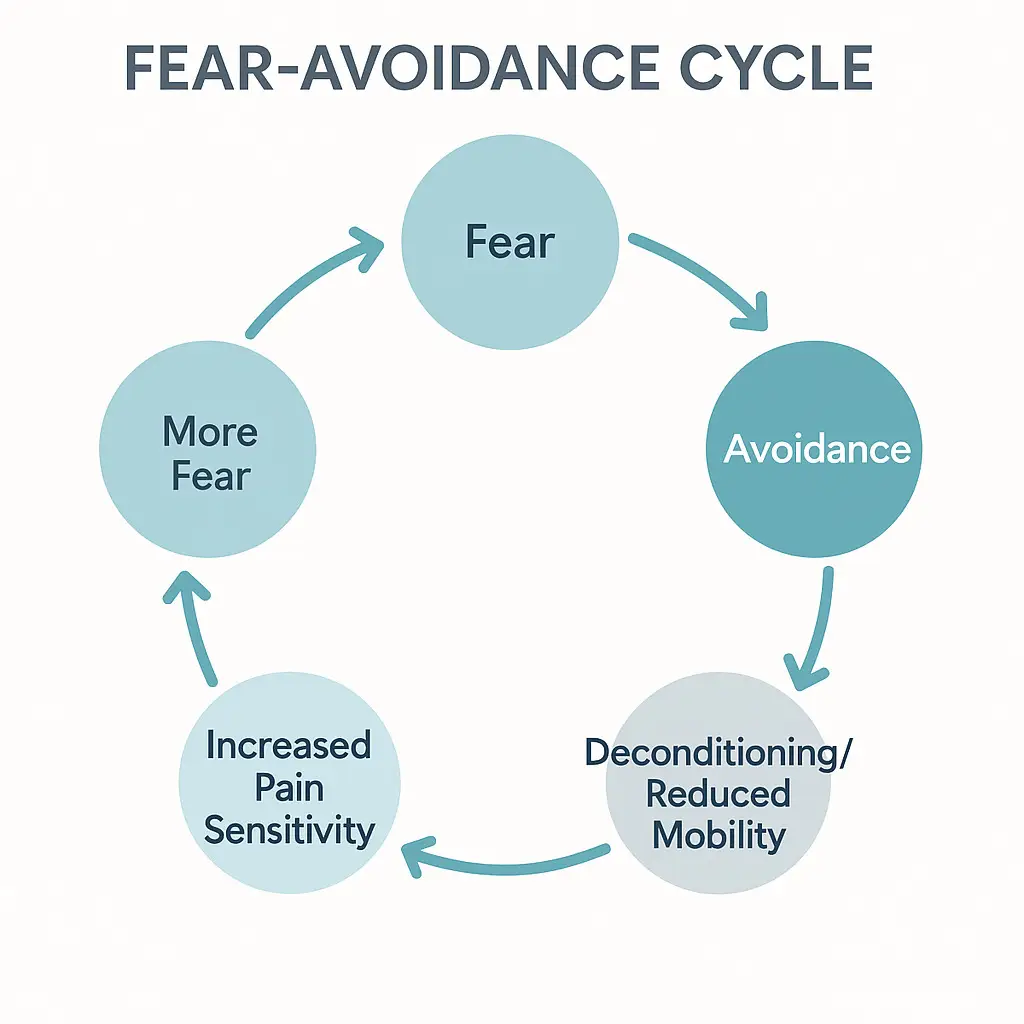
Physical deconditioning
Muscles weaken. Joints stiffen. Cardiovascular fitness drops. When you eventually do try the avoided movement, it actually does feel harder, because you have less capacity than you did six months ago. The pain that follows feels like proof that the movement was dangerous, when in reality the body is just out of practice.
Nervous system sensitization
The brain becomes hypervigilant. It scans for threat. Inputs that the nervous system used to filter out (a small twinge, a normal stretch sensation) get amplified and read as warning. This is called central sensitization, and it is one of the most well-documented mechanisms in chronic pain research. The pain volume gets turned up not because the tissue changed, but because the nervous system did.
Confirmation bias
You never get to find out if the movement was actually safe. Every time you avoid it, you confirm to yourself that it must have been dangerous. The belief gets stronger every time it goes untested.
The clinical observation that follows from this: in long-standing chronic pain, the work is rarely “fix the tissue.” More often, it is “give the nervous system the safety evidence it has not received.”
How Pain Reprocessing Therapy retrains the alarm
PRT is a structured, evidence-based approach to chronic pain that targets the brain’s pain prediction system rather than the body. It draws on neuroscience research showing that chronic pain in many patients is generated centrally (by the brain), not peripherally (by tissue damage), and that the brain can be retrained.
The treatment has three core elements.
Reattributing the pain
The first step is understanding, intellectually and viscerally, that the pain is real and the tissue is not the source. This is not a dismissal. It is a re-explanation. Once you understand that a hot stove sensation can sometimes come from a faulty wire instead of an actual flame, the same sensation feels different.
Somatic tracking
This is the practice you build through the work. You notice sensations in your body without labeling them as dangerous. You observe with curiosity instead of bracing against them. Over time, the brain learns that the sensation does not require a fear response, and the pain signal weakens.
Sending safety signals through movement
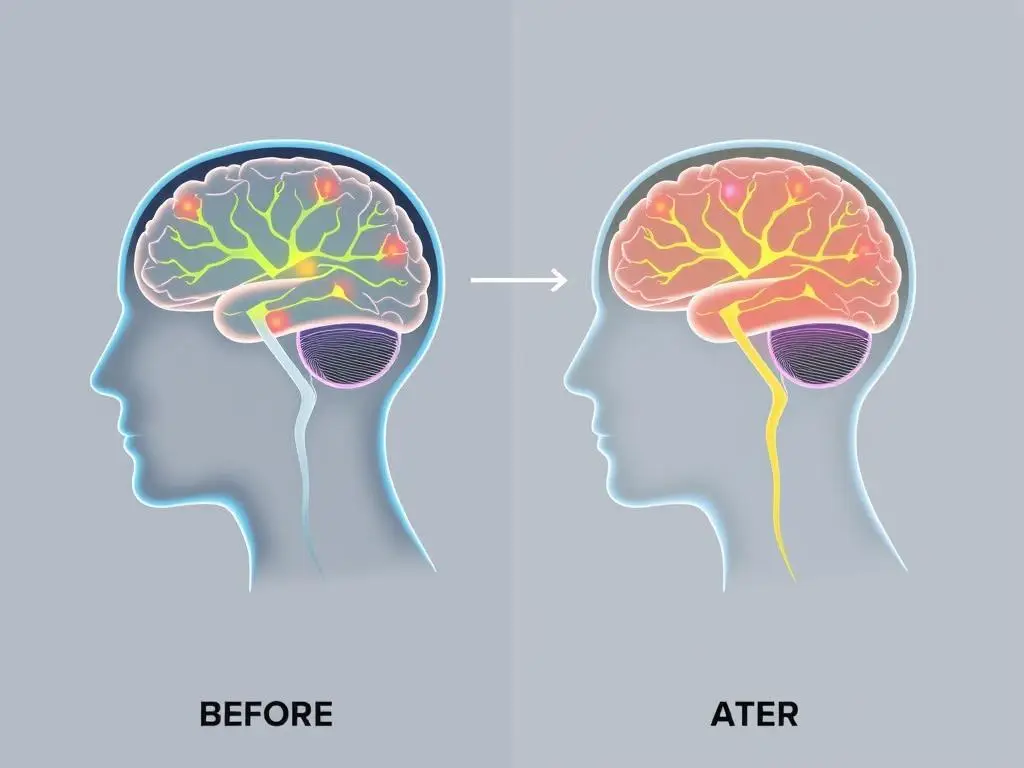
You move into the territory the brain has been avoiding, in small, deliberate, calm doses. Each successful exposure tells the brain “we did that, nothing bad happened.” The brain updates its threat map. The pain volume drops.
The biology underneath this is neuroplasticity. Your brain can rewire pain pathways throughout life. This is what made the Boulder Back Pain Study possible and what makes the approach work in the office.
Wondering if PRT might fit your situation?
PRT works best for chronic pain that has outlived the original injury and that imaging cannot fully explain. A 30-minute consultation can determine whether the approach is right for you.
How patients work through this in practice
Five things, in roughly this order, in the work I do with patients.
1. Approach with curiosity, not force
Forcing through pain (“just push through it”) tends to confirm the brain’s threat reading and increase the fear. Curiosity works better. Try this reframe: instead of “I have to bend forward,” try “I wonder what happens if I lean forward halfway and just notice.” The change in posture is small. The change in nervous system response is not.
2. Use graded exposure
Reintroduce the avoided movement in small steps. If forward bending feels threatening:
- Start with a gentle seated forward lean
- Progress to a standing lean with hands resting on a table
- Then a partial reach forward without support
- Then a full forward bend within comfort
Each successful step is data the nervous system uses to recalibrate.
3. Practice somatic tracking during movement
Before you move, take three slow breaths. As you move, notice what you actually feel: temperature, pressure, tension. Notice without grading. If fear shows up, label the fear (not the movement): “I notice I’m feeling afraid right now” rather than “this movement is dangerous.” Keep breathing steady throughout.
4. Get curious about the catastrophic thoughts
When a thought like “if I bend, I’ll damage my back” arrives, don’t argue with it. Don’t try to replace it with a “correct” thought. Instead, get curious about it, the way Motivational Interviewing teaches. A few questions I use with patients:
- What is the evidence for that thought? What’s the evidence against?
- What would you say to a friend who told you the same thing?
- Where does this belief come from? Was it something a doctor said?
- If you knew for sure the movement was safe, what would change this week?
This is intentionally different from the CBT-style “challenge the thought” approach. Motivational Interviewing draws out your own reasons to test the belief instead of telling you which thoughts are correct. People tend to follow through on conclusions they reached themselves.
5. Track and recognize wins
Keep a simple log. Movements that became easier. Activities you reclaimed. Moments when you chose curiosity over fear. The brain learns from feedback, and writing down a win is feedback.
How PRT fits with the rest of how I work
PRT is not the whole conversation when I see a chronic pain patient at Savera. It pairs naturally with two other things I do.
Motivational Interviewing carries most of the conversational work. It is the foundational counseling style in addiction medicine, which is one of my board specialties, and it transfers well to chronic pain. The job is not to convince a patient that their pain is in their head. The job is to help them notice their own ambivalence about activity and find their own reasons to test the avoidance pattern.
Medical evaluation matters too. Before doing PRT work, I confirm there is no progressive, structural, or red-flag cause that needs separate evaluation. The PRT approach is not for an undiagnosed cauda equina syndrome or a missed inflammatory arthritis. It is for the very common pattern of pain that has outlived the original injury and that imaging cannot fully explain.
When fear of movement needs a doctor’s eye first
PRT is not a substitute for ruling out the conditions that actually require medical or surgical attention. If any of the following are part of the picture, see a clinician before working primarily on the fear pattern:
- New numbness, weakness, or loss of coordination
- Loss of bladder or bowel control
- Unexplained weight loss
- Fever with the pain
- Severe night pain that wakes you up
- History of cancer
- Recent significant trauma
These do not mean PRT will not eventually be part of the plan. They mean the structural assessment comes first.
What changing the pattern feels like
The shift is rarely dramatic. It is gradual. A morning where you put on shoes without bracing. A walk that lasted ten minutes instead of five. A gardening session that ended because you chose to stop, not because your back made the decision for you. Those small wins compound. The neural pathways follow the new data.
Most people I see do not end up pain-free. They end up with a different relationship to pain. They notice it without panicking. They keep moving. They make decisions again.
If you have been living with chronic pain and fear of movement and want to know whether PRT might fit your situation, that is a conversation worth having. For more on the structured program at Savera, see our Pain Reprocessing Therapy services page or book a consultation.
Frequently asked questions
How long does it take to overcome fear of movement?
The timeline varies based on how long the pain has been present, how intense the fear is, and how consistently you practice. Some people notice clear improvements within weeks. Others take a few months to fully rebuild confidence. In the Boulder Back Pain Study, the structured PRT program ran four weeks and produced lasting effects at one-year follow-up for most participants.
Is some pain normal during this process?
Yes. Some discomfort is expected when you reintroduce movements your nervous system has been guarding against. The work is in distinguishing between manageable sensation (usually safe to continue) and pain that signals you are pushing too hard. Start with small, gentle movements. Progress gradually. Use somatic tracking to stay tuned in to what your body is telling you.
Can I do Pain Reprocessing Therapy on my own?
Some PRT strategies can be practiced independently. For long-standing or complex chronic pain, working with a trained clinician (a PRT-trained physician, psychologist, or physical therapist) provides the personalized guidance that the published evidence supports. The Boulder Back Pain Study used trained therapists, and that is the model with the strongest data.
What if my pain gets worse when I try to move?
Adjust the approach; do not abandon it. Try smaller movements, slower progression, or different positions. A temporary increase in sensation does not necessarily indicate damage. However, if pain is severe or accompanied by numbness, weakness, loss of bladder or bowel function, fever, or unexplained weight loss, contact a healthcare provider promptly to rule out a structural cause.
How is Pain Reprocessing Therapy different from talk therapy or pain coaching?
PRT is a specific evidence-based protocol with three structured elements: reattributing the source of the pain, somatic tracking, and sending safety signals through movement. General talk therapy and pain coaching can be helpful but are not the same as PRT and do not necessarily target the brain’s threat-prediction system the same way. The Boulder Back Pain Study specifically tested PRT.
Does fear of movement only affect people with back pain?
No. Kinesiophobia is well-documented across most chronic pain conditions, including low back pain, neck pain, fibromyalgia, chronic migraines, post-surgical pain, and complex regional pain syndrome. The mechanism is similar across conditions, so the same PRT principles apply.
Will Pain Reprocessing Therapy work for me?
That depends on your situation and requires an evaluation. PRT has the strongest evidence in chronic primary pain that persists after the original injury has resolved and that imaging cannot fully explain. If you have a clear structural cause that needs surgical or medical correction first, that comes first. If your situation fits the PRT profile, the published response rates are encouraging.
Call: (669) 270-2142
Visit: 16433 Monterey Road, Morgan Hill, CA 95037
This page is educational. It is not medical advice or a substitute for evaluation by your own clinician. For emergencies, call 911. For 24/7 support, call or text 988 for the Suicide and Crisis Lifeline.
Fear of movement is treatable. Pain Reprocessing Therapy helps retrain your brain to stop interpreting safe movement as dangerous. Read more about the fear-avoidance model or contact us to start your recovery.
Medically reviewed by Dr. Meenu Vaid, MD, Board-Certified in Internal Medicine, Infectious Disease, and Addiction Medicine, with Advanced Training in Pain Reprocessing Therapy. Last clinically reviewed on August 2, 2026.
This page is for educational purposes only and does not constitute medical advice. Reading it does not create a doctor-patient relationship. For emergencies, call 911. For crisis support call or text 988. Read our full medical disclaimer.