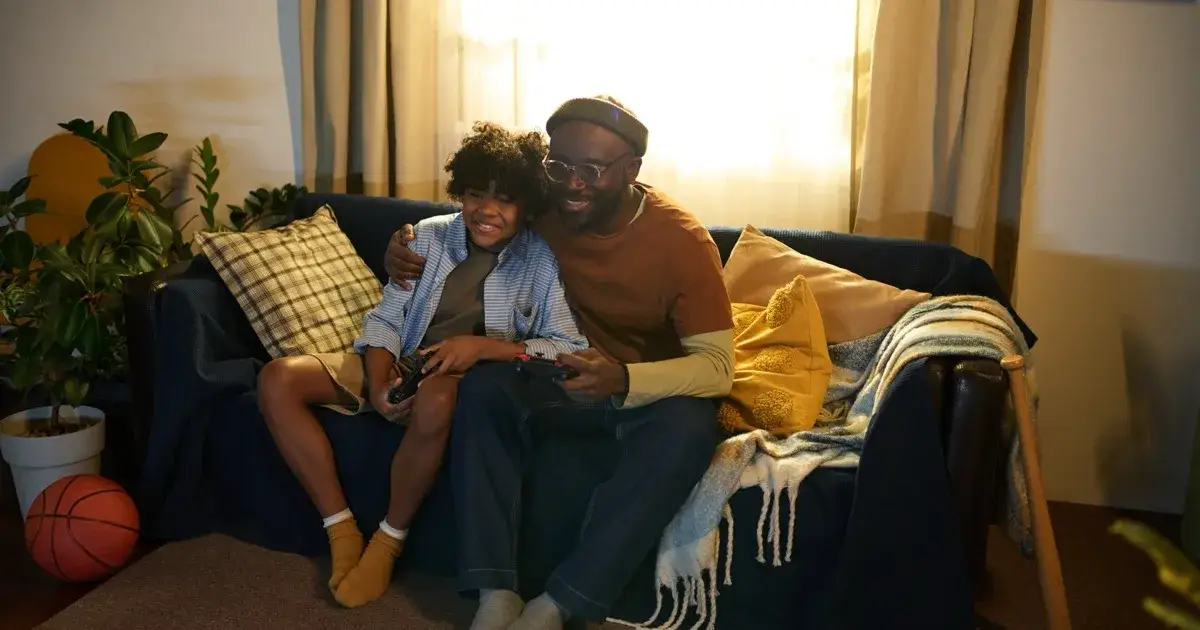
If your teenager games a lot, the useful question is not how many hours. It is whether gaming is displacing sleep, school, meals, and friendships, and whether they can stop when they want to. The American Academy of Pediatrics no longer sets a universal hour limit, because the evidence does not support one.
That is not permission to stop paying attention. It is a redirection of where the attention should go.
How do you tell heavy gaming from a real problem in a teenager?
The World Health Organization’s definition of gaming disorder has three parts, and each describes something you can watch for at home without a questionnaire.
| What WHO looks for | What that looks like in your house | What it is not |
|---|---|---|
| Impaired control: over when gaming starts, how long it lasts, and when it stops | They intend to stop after one match and it is three hours later. They have promised to stop earlier, more than once, and meant it each time. | Being annoyed at being interrupted mid-match. Games have save points and teammates, and stopping instantly is genuinely rude to other players. |
| Increasing priority: gaming takes precedence over other interests and daily activities | The team they loved gets quit. The friend group thins to only people inside the game. Dinner moves to the desk. Homework moves to 2 a.m. | Preferring gaming to homework. Most teenagers prefer almost anything to homework. |
| Continuation despite harm: play continues or escalates even as consequences arrive | The grades dropped, the coach called, the sleep collapsed, and the hours went up rather than down. | A bad term followed by a course correction. |
| Plus, required: significant impairment in personal, family, social, educational, or occupational functioning, normally evident for at least 12 months | A pattern that has held for the better part of a year and is measurably costing them something. | A hard six weeks after a move, a breakup, or a school change. |
Source: World Health Organization, ICD-11 gaming disorder (6C51) and the WHO gaming disorder FAQ. WHO also notes that gaming disorder “affects only a small proportion” of people who play.
The third column is there on purpose. Most of what worries parents lands in it. For the fuller observation list, read the warning signs that separate heavy play from a disorder.
Is there an hour limit that means my teenager has a problem?
No, and this is the most common thing parents are told that the evidence does not support.
The American Academy of Pediatrics answers this directly in its screen time guidelines Q&A, first answered in 2023 and updated in 2025. The AAP states that “there isn’t enough evidence demonstrating a benefit from specific screen time limitation guidelines,” and that its 2016 recommendations “do not give a set screen time limit that applies to all children and teens.” Instead it recommends “considering the quality of interactions with digital media and not just the quantity,” noting evidence that rules focused on “balance, content, co-viewing and communication are associated with better well-being outcomes than rules focused on screen time.”
The underlying policy statements agree. The AAP Council on Communications and Media’s Media Use in School-Aged Children and Adolescents, published in Pediatrics in 2016 and covering ages 5 to 18, says the evidence does not support a one-size-fits-all approach and directs families to build a media plan instead.
The research on gamers points the same way. Katz and colleagues, in the Journal of Behavioral Addictions in 2024, studied 14,740 highly engaged gamers to test exactly this question. Groups at risk of gaming disorder averaged around 42 hours a week. But 41.9% of the sample reported no psychological distress while averaging 26 hours a week. Their conclusion: even prolonged time spent gaming can be unproblematic for many gamers.
So two teenagers can play the same hours and only one has a problem. An hours-based chart cannot tell them apart. Impairment can.
This page used to carry a table assigning risk levels to hour bands, telling parents that four or more hours a day meant intervention was needed. It has been removed rather than corrected, because there is no better version of it. The numbers were not the problem. The measure was. We cover where the evidence puts the line on gaming hours separately, along with what the AAP actually recommends on screen time by age band.
What should you do first if you are worried?
Observe before you confiscate.
The instinct when you are frightened is to pull the console out of the wall. It usually costs you the thing you most need, your teenager’s willingness to talk about it, and turns a health question into a power struggle that leaves the health question unanswered.
Spend two weeks gathering information instead. Not surveillance, and not a spreadsheet you present as evidence. Just notice: what time do they actually fall asleep, are meals happening, has anything they used to care about quietly disappeared, and what happens when they try to stop on their own. That last one is the closest thing to a real test you have at home.
While you watch, ask what the gaming is doing for them. For many teenagers it is the friendship, not the game. For some it is the one place they feel competent, or an escape from something you have not heard about yet. Removing the escape without knowing what is being escaped is how parents lose the thread.
How do you talk to your teenager about gaming without a fight?
Lead with curiosity, not a verdict. “Tell me about this game” gets you further than “we need to talk about your gaming,” which every teenager hears as an accusation with the conclusion attached.
Keep it to observations rather than character. “You have been getting to sleep around three most nights and you look wiped out” is something they can respond to. “You are addicted” is something they have to defend against.
Ask what they think, genuinely. Many teenagers already know the hours got away from them and are relieved someone asked instead of announcing. Some will disagree completely, and that is information too.
Name what actually worries you, without exaggerating: sleep, the friend who moved away, the class they are close to failing. Concrete worries invite concrete answers.
Then negotiate rather than dictate. A limit your teenager helped set has a chance. One imposed at full volume on a Sunday night has none. That is close to how motivational interviewing works, the modality Dr. Vaid uses: the person considering the change does most of the talking about why.
What household rules actually work?
The AAP’s answer is to build a plan together rather than police a clock. Its Family Media Plan tool is free, designed to be filled in as a household, and puts the emphasis where the evidence puts it: balance, content, co-viewing, communication.
| The rule | Why it holds up |
|---|---|
| Screen-free zones, especially bedrooms and the dinner table | Protects sleep and preserves the daily moments when you would notice something was wrong. |
| Devices out of the bedroom overnight, charging somewhere else | Removes the single biggest mechanism by which gaming eats sleep. This one rule does more than any hour cap. |
| One screen at a time | Stops the drift where a game runs alongside homework and neither gets full attention. |
| Autoplay and notifications turned off | Removes the design features engineered to make stopping harder. It is a fairer fight. |
| Screen-free times the whole family keeps, adults included | A rule that applies only to the teenager reads as punishment. One that applies to everyone reads as a household value. |
| Room left for the other things: sleep, school, movement, in-person friends, unstructured time | This is the actual goal. Everything above is in service of it. |
Source: American Academy of Pediatrics, Family Media Plan, and the AAP policy statements Media Use in School-Aged Children and Adolescents and Media and Young Minds, both Pediatrics, 2016.
There are no product names here on purpose. This page used to recommend specific parental control apps with no basis given, which is not appropriate on a medical practice site. Software can help you enforce a plan. It cannot make the plan, and it will not survive a teenager determined to work around it.
What if sleep is the thing that is slipping?
Sleep is the harm with the strongest evidence behind it, and the one you can actually see.
A 2021 systematic review and meta-analysis by Kristensen and colleagues (PMID 34163386) pooled 34 studies covering 51,901 people. Problematic gaming was associated with shorter sleep duration (Hedges’ g = -0.238, 95% CI -0.364 to -0.112), poorer sleep quality (OR 2.02, 95% CI 1.47 to 2.78), daytime sleepiness (OR 1.57, 95% CI 1.00 to 2.46), and sleep problems overall (OR 2.60, 95% CI 1.94 to 3.47). The effect on sleep duration was larger in adolescents than in adults.
For a parent, that is the most useful finding here. You do not have to audit hours or argue about definitions. You have to know what time your teenager falls asleep, and whether that has changed. If it has, and stayed changed, act on it regardless of whether anything meets a diagnostic threshold.
Start with the device leaving the bedroom overnight. It is the smallest change with the largest effect, and far easier to negotiate than cutting play time.
What about ADHD, anxiety, or depression?
Problem gaming often shows up alongside other mental health difficulties. That matters, because treating the gaming while missing what sits underneath it does not work.
It is also outside what this practice can settle. Dr. Vaid is not a psychiatrist. She does not diagnose ADHD and does not treat depression, anxiety, or trauma. If any of that is in your picture, your child’s pediatrician or a mental health clinician is the right first call, and Dr. Vaid can coordinate rather than duplicate that care. If screens are the broader concern, how the same patterns show up with social media covers that ground.
When should a teenager see a doctor about gaming?
When something concrete has changed and stayed changed. Sleep has collapsed for more than a few weeks. Meals are being skipped. Weight or hygiene has slipped. They have genuinely tried to cut back, more than once, and could not. Every friendship outside the game has gone quiet. Or the conflict in your house has become the biggest problem in it. You do not need to be sure. Being worried is enough to book.
Here is what an evaluation with Dr. Vaid involves, and what it does not. She takes an unhurried history, looks at the whole picture including the medical parts overlooked when everyone assumes the issue is willpower, uses motivational interviewing, orders labs through an external partner laboratory when indicated, prescribes where appropriate, and connects you with a therapist who does the work she does not.
Controlled trials of gaming disorder treatment, pooled in a 2025 review by Harpas and colleagues (PMID 41187384) across 21 trials and 1,360 participants, show meaningful reductions in symptoms (g = 1.38) and gaming time (g = 0.90), sustained at 90-day follow-up, with larger effects in adolescents than in adults. Most tested cognitive behavioral therapy, including a 2022 cluster randomized trial in JAMA Network Open by Lindenberg and colleagues on preventing gaming disorder in adolescents.
Savera does not provide cognitive behavioral therapy, counseling, group therapy, family therapy, inpatient care, or residential care. Dr. Vaid refers those out to clinicians who specialize in them and stays involved in coordinating the care. That the evidence points somewhere she does not practice is worth saying plainly. The good news above is that adolescents respond better to treatment than adults do.
You can talk to a physician about your child’s gaming directly. If your teenager is the one asking for help, how to help a young person cut back is written for them.
If your child is talking about suicide or self-harm, or is in immediate danger, call or text 988 (Suicide and Crisis Lifeline) or call 911. Do not wait for an appointment.
Frequently asked questions
Is gaming disorder a real diagnosis?
Yes in ICD-11, where the World Health Organization classified it in 2018 and it entered into force on 1 January 2022. Not in the American Psychiatric Association’s DSM-5-TR, which places Internet Gaming Disorder in Section III as a condition for further study rather than a formal diagnosis. Both are accurate at once, and pages claiming the APA has fully recognized it are overstating the position.
How common is it in teenagers?
The estimates disagree, and the disagreement is worth knowing. A 2026 meta-analysis of 251,037 participants aged 6 to 18 pooled about 10% (95% CI 6 to 15), with extreme variation between studies. A 2021 meta-analysis of 226,247 participants across 17 countries found 3.05%, and 1.96% under stringent sampling. That 2021 review also found the choice of screening questionnaire explained 77% of the variance. Which survey you use changes the answer more than which country you are in.
Should I take the console away?
Not as a first move. A sudden removal converts a health concern into a conflict and costs you the conversation you need. Observe first, talk second, negotiate limits your teenager helped set. If gaming is their only social life, removing it without replacing it can make things worse.
Are boys more at risk than girls?
Diagnoses are more common in boys. The 2021 meta-analysis found a male-to-female ratio of roughly 2.5 to 1. That also means a meaningful minority of affected young people are girls, who get overlooked because the stereotype does not fit them.
My teenager says everyone plays this much. Are they right?
Gaming is close to universal, and the small share of players who develop a disorder is exactly why the diagnosis focuses on impairment rather than participation. WHO notes that gaming disorder affects only a small proportion of people who play. “Everyone plays” is true. It is not an answer to whether your teenager is sleeping.
Medically reviewed by Dr. Meenu Vaid, MD, triple board-certified in Internal Medicine, Infectious Disease, and Addiction Medicine.
Last clinically reviewed on August 5, 2026.
This article is for general educational purposes only. It is not medical advice, and reading it does not create a doctor-patient relationship. Always seek the advice of your physician or another qualified health provider with any questions you may have about a medical condition. See our full medical disclaimer.
In a medical emergency, call 911. If you or someone you know is in crisis, call or text 988 to reach the Suicide and Crisis Lifeline.
Savera is a direct-pay practice in Morgan Hill, California. Insurance is not billed. HSA and FSA are accepted.